
The Importance Of Getting Value With Every Pick

I want to talk about value. Specifically, getting as much value as possible for every draft pick. Every fantasy owner knows this but so often this mentality is abandoned usually after the third round. I believe this occurs either because owners don’t know how to value players statistical output properly and/or they’re not paying attention to what statistics are on sale.

Fantasy baseball is all about accumulating statistics. Therefore, before the draft even begins every owner has to have statistical thresholds for every statistical category. Having thresholds are like the stars to the sea captain.

If you’re playing in a Roto format I recommend calculating the total statistics, you will need to finish third in every category. I recommend third because if you finish third in every category you should have enough points to win the league. Let’s look at a current example of owners not properly evaluating a player’s statistical output.

Joey Gallo has an average draft position (ADP) among hitters of 69 at NFBC. (If you want real ADP data always go to NFBC because every owner has spent a lot of money to play so you know everyone is trying their best.) I personally have him ranked 109. I’m projecting a .210 batting average with 40 home runs, 92 RBI, 83 runs and 3 stolen bases. You may think I’m pessimistic on Gallo, but let’s look at the projections on FanGraphs (below).

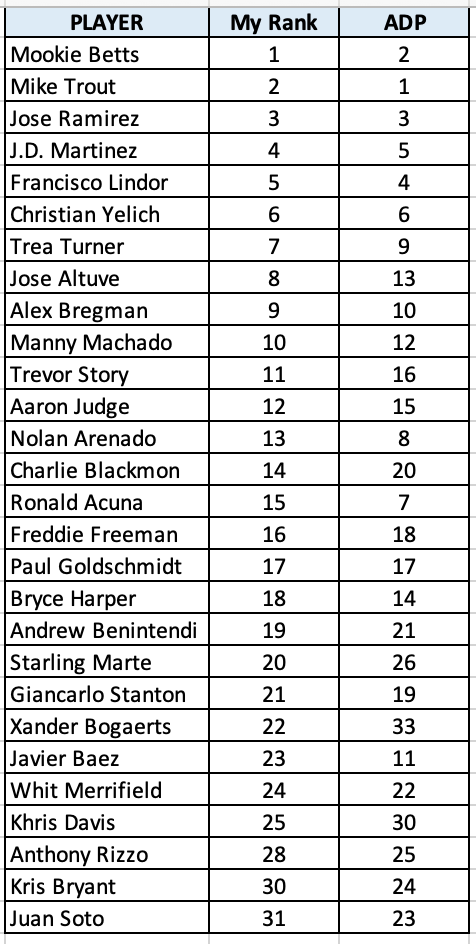
fangraphs-2019-galloMy projection is more bearish compared to the projection systems, but I’m in the ballpark (pun intended). You may be thinking my formula is not valuing home runs properly or my formula is trash. Let’s look at my top 25 hitters versus the top 25 hitters in ADP at NFBC below. (I used ADP data before Francisco Lindor’s injury.)
top-25-hitters-2019

For the most part I’m sharing a brain with everyone. Of the 28 players listed my rankings are five or less draft spots away from everyone. You may be thinking I’m not valuing power properly but I’m higher on JD Martinez and more importantly, Khris Davis.


So why is there a 40-point difference in ADP for Gallo? It’s a combination of these three reasons: A) his owners are more bullish on his home run totals and think the batting average will improve, B) his owners want to lock in 40 home runs and C) Gallo provides elite output in the home run category.

I can understand the first reason but even if someone is projecting 45 home runs his ADP shouldn’t be that high. The other two reasons further represent why fantasy owners are losing value at his ADP. If Gallo is worth a 11th round pick and someone drafts him in the 7th round, then that person is overpaying for his statistical output. Suppose the 7th round pick has a value of $20. If you take Gallo, whose only worth $15, at a slot that demands you get at least $20 of value you’re putting your team at a deficit. If you continue to overpay for players you’re going to have a mediocre team at best.

Sometimes it is beneficial to overpay, but you should do that for only one or two picks. If you’ve drafted speed-first players who offer no power (Billy Hamilton or Dee Gordon) it could be worth to overdraft Gallo because you will need his power to reach the necessary home run totals. However, I bet most owners are not employing that strategy.

Summary: rank all the players and compare your rankings with NFBC’s ADP. This will allow to find bargains and not overpay for players. At the end of the draft if you have got more value than anyone else you have a great chance of winning your league.


 

Posted in Fantasy Baseball | Leave a comment

Adalberto Mondesí’s Fantasy Value for 2019

Every fantasy offseason there are a small number of players every website discusses. These players usually have a combination of two attributes: A) immense physicals traits and B) have unproven track records in the majors (i.e. at most a partial season in the majors). These players are discussed so much their fantasy value becomes large their ADP (average draft position) makes it almost impossible to make any profit.

Last year it was Shohei Ohtani and Ronald Acuna. Two years ago, it was Trea Turner. In 2016 Gary Sanchez and Cory Seager. Every draft season pundits and fantasy players obsess over these players. I promise everyone, and their mother are going to have opinions on Adalberto Mondesi and Vladimir Guerrero Jr.

What’s fascinating about people in general is they’re the allure of the dream of what could be. I feel like this phenomenon ingrained in human nature. The known is never as attractive as the unknown. Maybe we love to gamble? Maybe we want the bragging rights for the season and/or for the rest of our lives? “When I was young man I drafted Ronald Acuna. I knew he would be something special.”

Mondesi has a lot of in common with the Trea Turner. (*When I refer to Turner I am referring to him as the player he was heading into drafts two years ago). They both had incredible half seasons, they’re playing this year at age 24 and they have the raw ability to hit 20 home runs and steal 60 bases. The scouting reports say Turner is miles ahead of Mondesi in regards to approach and bat-to-ball ability, which means Mondesi far more risk than Turner.

Most fantasy experts are projecting Mondesi to hit in the .235-.250 range, which is reasonable. I take a simple approach to projecting players. Obviously Mondesi had a great half season last year, but don’t overlook the 209 plate appearances he had prior. In 500 plate appearances in the majors he’s hit .238 with 14 home runs, 46 stolen bases with 67 runs and 53 RBI. I think he can hit .245 but those numbers are on-point and I’m using those as my projection.

It’s too early for reliable NFBC data but I think he goes in the third and fourth rounds of 12 and 15 team drafts, which means I will not be drafting him this year. If goes that early people are looking mostly at the upside: A) the brief track record, B) the Royals will be bad, so he’ll play every day and C) as long as Ned Yost is the manager Mondesi will rarely have the red light when standing on first base.

However, there is just as much downside. His bat-to-ball skills and patience are very erratic and can be exploited. It’s very possible after the first 4-5 weeks he’s hitting .170 with a .220 on-base. If this happens even Ned Yost will have to move Mondesi down in the lineup. (it’s also possible Billy Hamilton gets off to fast start while Mondesi struggles and Hamilton gets the leadoff spot).

Another possibility is his inpatient approach gets exploited. Its possible pitchers didn’t watch that much film of Mondesi last year and he snuck up on pitchers. In his brief stints in the majors in 2016-17 he struck out 33% of the time. Last year it was only 26.5%. It’s possible his strikeout rate goes back to the 30% range. If that happens it will be difficult to hit .240 let alone .250.

Every pick in a draft has an expected value. It is up to the owner to get as much value for every draft pick. For example, suppose the 30th pick has a value of $10. Your job is to try to get $10 or more of expected value. If you draft someone who only generates $5 you’ve lost half of your value and you have to get extra value somewhere else in the draft. Mondesi’s value has a wide range of outcomes, which means drafting him in the third-fourth round is extremely risky.

Posted in Fantasy Baseball | Leave a comment

2018 Fantasy Baseball Season Recap

Yesterday the regular officially ended. Usually the first day after the regular season ends is a mix of emotions. I’m sad baseball will no longer be available to watch every day on MLB.tv  and I hate the winter…especially since I moved to Portland, Oregon. The end of the regular season means winter is coming soon and the weather will be bad for the next 4-5 months. Also, the end of the regular season is usually full of disappointment because I never win my NFBC leagues. I’ve finished in second and third place before but actually coming in first has eluded me.

Screen Shot 2018-10-02 at 10.05.12 AM
However, this season I won both my leagues. After my drafts I did a recap of both drafts: $150 buy-in and $500 buy-in; both leagues were 12-teams. What’s funny is I didn’t feel that happy about it. I mean, I enjoyed winning but both teams were in first place for quite awhile. One league I was in first for the last 2-3 months and the other I was in first starting late August. I know no one is going to read this but I wanted to summarize what I’ve learned this season and in general.

I’ve been playing NFBC for about 5-6 years now and the buy-in amount does not correlate to skill level of the owners. In fact I think owners at the $150 level are smarter and better fantasy players than people who pay more.

Read Winning Fantasy Baseball by Larry Schechter. It was written a couple of years ago but it is still highly relevant. The ideas in the book provide a great starting point on how to evaluate players and how to contextualize each players statistics.

Don’t get burned out. This year was the least amount of baseball I’ve watched since I started playing NFBC. In the past I felt the need to watch the pitchers on the free agent wire because it would reassure the bids I was making. However, by the time it came to put in my FAAB bids I would be too burnt out to put in the hour or two of work necessary. That’s just me not having enough time to watch baseball 10-20 hours a week and do 1-2 hours on the waiver wire. Also, by spending less time watching I was more energized and refreshed when I was on the waiver wire.

Always check the waiver wire. Honestly, in years past, I didn’t check the waiver wire every week because I thought my team was solid. “There are no better players available,” I would say some weekends. Even if you have a great team, check the players available every week. You never know what you’re going to find.

On May 18th, in my $500 league, someone dropped Matt Carpenter. I was in first place and I didn’t really need Carpenter but I saw a big opportunity. Carpenter was hitting .160ish but I looked at his underlying statistics and I still saw someone who could hit .265ish with 30 home runs. I put in a massive bid and got him (below).  After I acquired him he proceeded to hit .277 with 33 HRs, 76 RBI, 73 R & 4 SBs. Why didn’t anyone want him?!

Screen Shot 2018-10-02 at 10.30.29 AM
Always stay true to your evaluations. Do not let anyone else’s opinion bias yours. I learned this back when Jacob deGrom and Andrew Heaney were rookies. Both pitchers maybe had 5-6 starts under their belts. I was debating which player to drop (I have no idea why I was looking to drop either of them). I watched all of their starts and deGrom was easily the better pitcher, but I read a couple of articles from authors I respect and they said Heaney was the better pitcher. I dropped deGrom and I finished in 4th or 5th.

Buy $10 of value for $5. A lot times a players name value increases or decreases their value despite their output is almost identical. When you draft players you’re drafting their statistical output. Nothing more, nothing less. If you can get 3o home runs in both the 5th and the 10th round then get the player in the 10th. I don’t care if those home runs come from a player I love in real life (Eugenio Suarez) or from a player I dislike in real life (Ryan Braun). Every year players go much later than they should for no obvious reasons other than their name value.

Position scarcity (other than catcher) does not exist. Heading into this season players at the MI position had more value than the CI position. Growing up in the 80s and 90s the MI position was full of guys who couldn’t hit, but that is no longer the case. I wouldn’t be shocked if 40-50% of the top 20 hitters drafted next year will be at MI. Also, outside of the top 10 first and third basemen there all pretty comparable to the 14th MI.

Have a rough estimate of what statistical output is necessary to finish third in each category. If you know where you’re going it makes drafting a breeze. You will know how many home runs you need to draft and you’ll know what statistical output is on sale. In 2018 it was low batting average hitters who hit a lot home runs. Khris Davis, Joey Gallo and Miguel Sano were all undervalued because of their low batting averages. However, if you draft players in the early rounds who will have high batting averages you can draft these guys and not take a hit on the batting average.

When you’re drafting total up the statistical output you’re acquiring. This sounds easy but you would be surprised how many people do not do this. If you know you already have enough stolen bases then the decision between someone like Ender Inciarte versus Matt Chapman is an easy one.

Don’t do mock drafts. Instead, create a draft matrix. Its not as difficult as it sounds. This is only useful for snake drafts. Basically, you look at the players that will be around your draft position and you write down which players you want will be available. So, if you have the 24th pick you want to look at the ADPs of players see which players have a 22-30 ADP. Example, if Christian Yelich has an ADP of 26 odds are he’ll be available at 24. You do this for every draft pick and all of sudden you created your own mock draft. I love NFBC so much because all the people have spent money to play and they all want to win which means the ADPs are “real”. Lastly, this process tells you statistical categories are undervalued. Like I mentioned previously, low batting average power was undervalued this year.

Posted in Fantasy Baseball | Leave a comment