This year I participated in two leagues. The draft took place on April 1 at 9pm EST. In terms of the player commentary, there are some similarities in the players I drafted. I didn’t want to repeat myself so I encourage you to see my write-up on my other draft.
League Background
This is a 12-team mixed NFBC draft. The roster consists of 14 hitters, nine pitchers and seven bench players. You set your pitchers once a week; hitters are set twice a week; waivers occur once a week.
Overall Thoughts
This team has a lot of similarity to my other team. I am a little reliant on Guardians with Jose Ramirez and Franmil Reyes and I’m banking on Oneil Cruz coming up to the Majors in a couple of weeks. My starting pitcher staff isn’t quite as deep as my other team but I think I’ll end up in the middle of the pack which is all I need to win the league.
Below are my draft picks:
Player
Round
Pick
Ramirez, Jose
1
3
Perez, Salvador
2
22
Marte, Starling
3
27
O’Neill, Tyler
4
46
Kimbrel, Craig
5
51
Varsho, Daulton
6
70
Romano, Jordan
7
75
Reyes, Franmil
8
94
Adames, Willy
9
99
Lopez, Pablo
10
118
Votto, Joey
11
123
Cruz, Oneil
12
142
Gray, Sonny
13
147
Benintendi, Andrew
14
166
Segura, Jean
15
171
Lowe, Nathaniel
16
190
Verdugo, Alex
17
195
Nimmo, Brandon
18
214
Gray, Jon
19
219
Means, John
20
238
Gonsolin, Tony
21
243
Rasmussen, Drew
22
262
Urias, Luis
23
267
Frazier, Adam
24
286
Lowe, Josh
25
291
DeJong, Paul
26
310
Megill, Tylor
27
315
Gonzales, Marco
28
334
Cooper, Garrett
29
339
Odorizzi, Jake
30
358
Jose Ramirez was my second rated hitter so I got a slight discount. He’ll play the year at the age of 29 so I think the stolen bases decreases; the question is how much. I projected 20 but I wouldn’t be surprised if he only steals 10-15.
I’ve drafted Starling Marte for seemingly for the past 4-5 seasons. He’s always been undervalued except for this year. Marte probably leads off or bats second and should score 100 runs with 25-30 stolen bases.
Tyler O’Neill brings a lot of raw power and the ability to steal 10-20 bases which is exceptionally rare. Among qualified hitters he had the 8th hardest hard hit rate. He got lucky with the batting average last year; I only projected a .260 average but his bat is good enough that he should hit 3rd or 4th all year and be a really good statistical accumulator.
Joran Romano was the best closer available.
I picked Willy Adames off waivers for free last season. I think leaving Tampa and being able to see the ball was a huge difference for his offensive production after being traded. The batting average will probably be in the .250s but he should provide production in every category.
Joey Votto made a lot of hard contact last year. In fact he was 6th in all of baseball last year. Votto spoke about a change in his approach last year and the advanced metrics show it. I projected 31 home runs but I wouldn’t be surprised if he hits a career high this year. The new power comes at the expense of the batting average; I think he’s a .250 hitter.
I selected Oneil Cruz based on the hope he’s in the Majors in 2-4 weeks. Cruz already made it to the Majors and if he played a full year he’s a potential 30/30 candidate. The Pirates just signed Ke’Bryan Hayes for $70 million; why not bring up Cruz and showcase both players to their fanbase. Kevin Newman, the current shortstop, is a little bit above replacement level. Barring injury I don’t know why Cruz is still in the minors on May 1.
I drafted Alex Verdugo primarily for his batting average. He does a little bit of everything else which means if he doesn’t hit for average I may have overpaid.
John Means benefits the most with the fences further out left field.
Luis Urias is currently injured but the reports are he should only miss 1-2 weeks. I drafted Urias and Frazier back-to-back as placeholders for Oneil Cruz. My thinking is Frazier scores a lot of runs for the first three weeks and then Urias is healthy and hits for power; and the combination of both players is similar to what Cruz would have provided…in theory.
Adam Frazier is a placeholder until Oneil Cruz gets called up. Frazier should bat leadoff to begin the season and if he does I think he can score 100 runs. The batting average regresses but he should hit safely in the .270s with 5-10 stolen bases.
I drafted Josh Lowe as a late round lottery pick. My thesis was if Kevin Kiermaier gets hurt, Lowe would be the first player called up. Well, it turns out Austin Meadows got traded to Detroit which means Lowe got the call up. I think Lowe could steal 20-30 bases if he played every day. The fact he batted 7th against a lefty encourages me that he will play most days.
Marco Gonzales and Jake Odorizzi were both dropped three days later for Mitch Keller and Madison Bumgarner. They were dropped because Bumgarner had a better week one matchup and he had a velocity uptick in the spring. Keller was a lottery ticket pickup; if he reaches his supreme ceiling, which is highly unlikely, he’s a top 10 starting pitcher. If Gonzales and Odorizzi reach their ceilings they’re top 30 starting pitchers. Lastly, I’ll be able to find pitchers like Odorizzi and Gonzales on waivers all year.
This year I participated in two leagues. This draft took place on April 4 at 8pm EST.
League Background
This is a 12-team mixed NFBC draft. The roster consists of 14 hitters, nine pitchers and seven bench players. You set your pitchers once a week; hitters are set twice a week; waivers occur once a week.
Overall Thoughts
I did this draft second and I like this team much more, which probably means this team will do poorly and the other will be better. The biggest weakness are the relivers especially if MattBarnes gets/is hurt. I think I’ll easily have the best offense in the league.
Below are my draft picks:
Player
Round
Pick
Harper, Bryce
1
9
Perez, Salvador
2
16
Mullins, Cedric
3
33
Varsho, Daulton
4
40
Bogaerts, Xander
5
57
Kimbrel, Craig
6
64
Chisholm Jr., Jazz
7
81
Bregman, Alex
8
88
Reyes, Franmil
9
105
Lopez, Pablo
10
112
Barnes, Matt
11
129
Snell, Blake
12
136
Benintendi, Andrew
13
153
Gray, Sonny
14
160
Lowe, Nathaniel
15
177
Segura, Jean
16
184
Hayes, Ke’Bryan
17
201
Winker, Jesse
18
208
Kepler, Max
19
225
Gray, Jon
20
232
Gonsolin, Tony
21
249
Nimmo, Brandon
22
256
Smith, Kevin
23
273
Rasmussen, Drew
24
280
Keller, Mitch
25
297
DeJong, Paul
26
304
Hendricks, Kyle
27
321
Cooper, Garrett
28
328
Lamet, Dinelson
29
345
Bumgarner, Madison
30
352
Bryce Harper was 6th rated hitter overall so I got a little discount. The biggest downside for Harper is maybe only steals a couple of bags instead of the 12 I projected. He plays in a great ballpark and the offense is vastly better than last year. If he repeats last year’s ability in this revamped lineup he could drive in 120-plus RBIs.
Salvador Perez was my 5th hitter overall simply because of the scarcity of being in a two-catcher format. For some reason the Market has caught on to the vast difference between Perez and the 24th best catcher Kyle Higashioka. The last catcher in this format is considerably worse than the last player at any other position. Perez was lucky with the home runs and the batting average. His contact rates suggests he’ll hit in the .240’s; I projected him for a .245 average with 37 home runs and 100 RBI. With Bobby Witt in the lineup and the fact the Royals may DH Perez half the time means he should play every day which is rare for catchers. Most importantly, the rest at DH means there’s a bigger chance the offense doesn’t tail off in the second half of the season.
Cedric Mullins is a 20/20 player who should score close to 100 runs. The fences in left field at his home ballpark have gone back but that shouldn’t really effect his power output that much. By my rough estimates he’ll lose about two home runs.
Daulton Varsho should play every day in the outfield and could steal 10-15 bags with 15 home runs. Getting steals at catcher is extremely rare. I actually wanted Xander Bogaerts with this selection but I got antsy and decided I wanted to lock in the steals from Varsho and as you can already tell I got Bogaerts with my next pick so it wall worked out in the end. By getting 10-15 steals from my catcher position allowed me more flexibility in the draft. Now someone who doesn’t steal, like Jesse Winker, becomes more valuable. I projected 16 home runs, 11 stolen bases, a .250 average with 85 runs. I assumed he would bat leadoff against righties.
Xander Bogaerts was my 16th rated hitter. He’s the classic accumulator type of player; I expect 100 RBIs and 100 runs scored. The power and stolen bases are not overwhelming but he will hit in the .290s which allows more batting average freedom during the draft.
Craig Kimbrell comes with some risk because in the past he’s totally lost his control and therefore can be very hittable. Also, he may only get 60 innings pitched which means he only gets 85-90% of the save chances. However, with his track record and contract he should have a long leash if he hits roadblocks during the season. The Dodgers could be the best team in baseball so if only gets 85% of the saves he should get 30-35 saves with a lot of strikeouts.
I think teams this year underrated stolen bases. Jazz Chisholm was my 58th rated hitter but I got him with the 81st pick. What’s good about getting a Bogaerts is even with Chisholm hitting in the .240s, it doesn’t hurt as much because Bogaerts picks up the slack. I think Chisholm is a 20/20 player again; I thought he would hit in the top of the lineup but in the first game of the year he batted ninth. He hits in the bottom third all year then I didn’t make a profit on this draft pick.
Alex Bregman at this price point is either a huge profit or a huge loss. If he plays a full year there’s no way he’s the 88th best player. Bregman struggled last season dur to wrist issues and it looks he’s recovered. He’s a free agent at the end of the year so he has every incentive to do well this year. Bregman was my 24th rated hitter overall. Like Bogaerts, Bregman is another accumulator but he’ll hit in the .270s instead of the .290s.
Below are my projections for Pete Alonso and Franmil Reyes; I had Alonso rated 48th and Reyes 57th. Winning drafts is all about paying a discount. Alonso was being drafted at fair value but Reyes was a big discount. Reyes doesn’t have a position so he “clogs” your utility spot which can be annoying at times but there shouldn’t be that big of a discount for similar output.
Pablo Lopez was my 22nd rated starting pitcher. I honestly don’t have much to add about pitchers in general. I regress their advanced metrics based on their previous statistics and I use Eno Sarris’ rankings to come up with my projections.
I think Matt Barnes is relatively safe at his price point. On the first game of the year Barnes wasn’t available to pitch due to back issues and the Red Sox promptly blew a save chance. If Barnes can play a full year I think he can have 25 saves.
Blake Snell was drafted for the strikeouts and how he looked at the end of last season. I think if you take the average of Snell and Kyle Hendricks I get two top 40 pitchers at a big discount.
Andrew Benintendi is going to bat 3rd all year in a pretty good lineup and should provide statistics in all five categories. Could he hit .280 with 15 home runs, 90 RBI and 15 steals? I think its certainly reasonable.
I like the ballpark change for Sonny Gray.
Nate Lowe is another all around contributor. A lot of fantasy experts think Lowe can hit for more power. From my analysis I don’t think its possible; I projected 22 home runs. He should in the middle of the order and steal 5-10 bags.
Jean Segura is another all-around contributor…are you seeing a trend so far? Even though he’ll hit 6th or 7th I think the offense is good enough he can drive in 70 and score 70 runs. Also, if there’s an injury to one of the Phillies best hitters it’s possible Segura leads off.
I wasn’t buying the Ke’Bryan Hayes hype last season. The fact he vastly under performed his ADP probably made him a bargain this year. I projected 14 home runs and 12 stolen bases with a .270 average. The Pirates are really bad but I have to assume O’Neil Cruz gets called up in a couple of weeks and if that happens the biggest benefactor is Hayes. I don’t understand the Pirates giving Hayes all that money; I think he’s just an average regular but I hope I am wrong.
I can’t believe Jesse Winker fell to this far in the draft. He probably only plays half the time against lefties because he hasn’t shown the ability to hit lefties and the change of ballpark hurts his value. However, the hate went too far. He went seven picks ahead of Lane Thomas. I like Thomas but Winker was an MVP candidate last year. I projected a .279 average with 22 home runs and 85/85 runs and RBI.
Max Kepler was selected because I wanted someone with power to hit mid-20s home runs and who could steal 10 bags.
Jon Gray was selected because his pedigree and the change of ballpark. It’s very possible he’s a top 30 starting pitcher or this year’s Andrew Heaney.
The Tony Gonsolin selection was based on his ratios and the fact he’s starting for the Dodgers (i.e. a higher probability of getting wins).
If Brandon Nimmo can stay healthy he’s this year Mitch Haniger; a player with a lot of talent who no one wanted but if he stayed healthy would be very good.
Is it possible Kevin Smith goes 20/20 and is the AL Rookie of the year? Smith is going to play every day and his defense is good enough so he won’t be a liability. If Smith hits he could be bat third on that team.
I selected Drew Rasmussen based on his raw abilities. He may only throw 130 innings but I think those innings will be very good.
The selection of Mitch Keller was simply to see what he can do. The raw stuff has always been there. If the control improves a little he’s a top 50ish starter; I also wouldn’t be surprised if he’s the closer next year. Keller is a lottery ticket.
In 2019 Paul DeJong hit 30 homers and stole 9 bags. He’s only 28 years old and I don’t think he’s done. If he is, I didn’t pay a lot for him.
I wrote about Kyle Hendricks in the Blake Snell section. Hendricks won’t get that many strikeouts but he should have good ratios which should counterbalance Snell’s bad ratios. Also, the Cubs should be an average team which means Hendricks may get 12-13 wins.
Why does the Market dislike Garrett Cooper? He is hitting in the top of a good lineup and has a career .282 batting average with a .354 OBP. Sure, he may only hit 15-20 home runs but as a 6th outfielder you can do a lot worse. I get 2004 Jeff Conine vibes from Cooper.
Dinelson Lamet with the shortened week against a bad Diamondbacks team I thought it was possible he gets a win or two. He’s another player that probably gets cut after the first weekend.
I selected Madison Bumgarner because he was starting week one and he had a pretty good matchup. If the advanced statistics say he’s not looking good then I will cut him.
Nothing discussed/written should be considered as investment advice. Please do your own research or speak to a financial advisor before putting a dime of your money into these crazy markets. In other words, if you buy something I bought, you deserve to lose your money.
The only reason why I am making my portfolio public because it provides accountability to me. Some or all the analysis I provide could befrom the top of my head and should not be considered accurate.
My investing goal is simple; to try to manage risk while being fully invested without market timing. Howard Marks said it best, “even though we can’t predict, we can prepare.”
All my references to the Market are only for the US Market.
Performance
In Q1 my stock portfolio was down 2.76% compared to a negative 4.63% for the S&P 500.
“At certain speculative junctures, prudence itself becomes unprofitable, and this juncture – say, the five or six years starting in approximately 2015 – has been the showcase of that paradox. Reaching for yield and chasing after performance were once what a conscientious fiduciary would never stoop to do. In the age of ZIRP (and the full heat of indexation), those offenses against good practice became almost compulsory.” ~The Nov. 26 edition of Grant’s Interest Rate Observer
Portfolio Activity
In Q1 my stock portfolio was down 2.76% compared to a negative 4.63% for the S&P 500.
There was much more activity in my account that I anticipated. At the start of the year I sold ZIG because the fund no longer had a short book; I wanted to tax loss harvest losses so I sold GLRE. On the day Russia invaded Ukraine I sold out of all my UK and Russian exposure. I also punched out of Schmitt Industries.
(Quick aside to Russia and its war with Ukraine. I read everything I could about what was happening at the border of Ukraine. I concluded Russia was posturing and there was a small percentage a shot would be fired. Obviously that was wrong. When Russia invaded Ukraine I immediately sold all my Gazprom and Russia ETF shares. It wasn’t difficult to sell; rather, I was extremely annoyed that my 100% return became a 10% return. The learning I took from this experience is I immediately acted when my thesis changed; I didn’t hesitate. I think two years ago I wouldn’t have sold and waited it out. Lastly, the Russian assets are incredibly cheap but I no longer wanted to profit from the war.)
I made new positions to Intel, Crescent Point Energy, ConocoPhillips, EOG Resources, Prosus, Citigroup, British American Tobacco, Petroleo Brasileiro and a basket of international and emerging market ETFs. I added to my existing positions in Schwab, Aimia and PLx Pharma.
Company Commentary
Intel
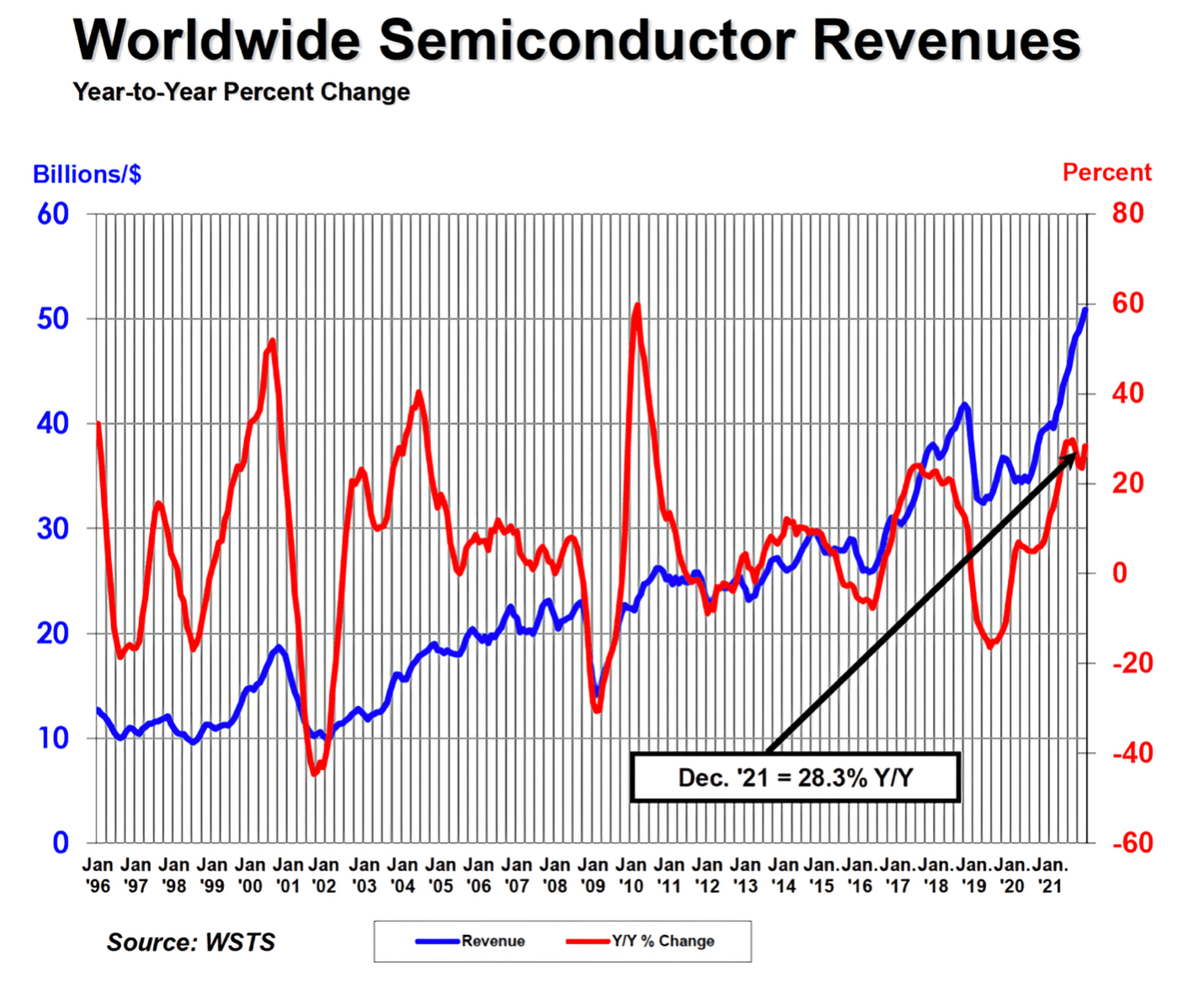
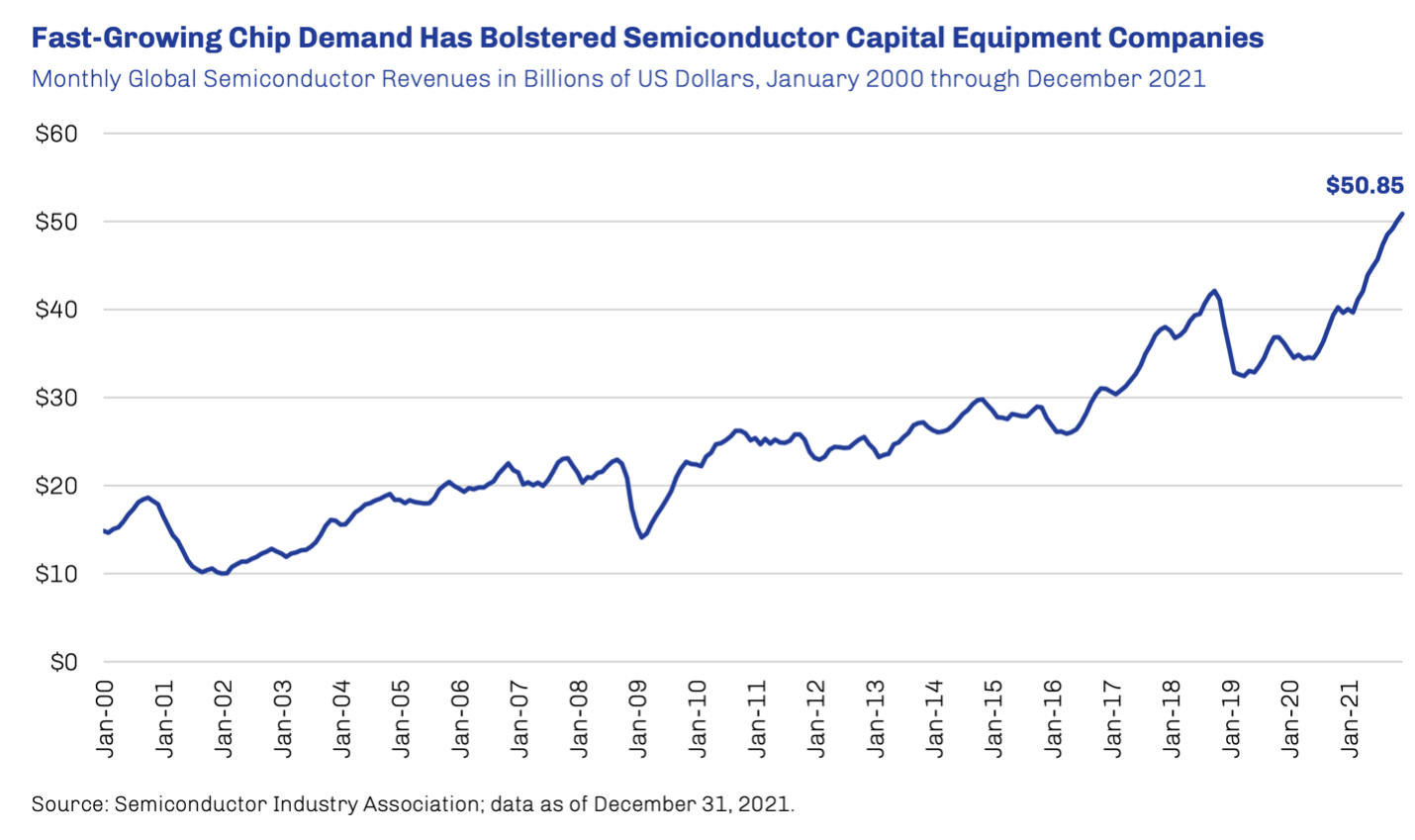
My thesis for Intel is the company is they are essentially a defense company and Intel’s industry has tremendous headwinds (two images below) in the long term.
Global sales, for the industry, in December 2021 were $50.9 billion, an increase of 28.3% compared to the December 2020 total and 1.5% more than the total from November 2021. Fourth-quarter sales of $152.6 billion were 28.3% more than the total from the fourth quarter of 2020 and 4.9% higher than the total from third quarter of 2021.
The industry had a violent cyclical nature in the 1980s and 1990s but now there are fewer players and the players that exist are better capitalized. Also, chip demand today is being driven by the need for innovation because competition for the end users (i.e. the companies that are receiving the chips) is much greater.
Semiconductors is one of the most important hard assets in the world because the hardware is used in everything we do. In my opinion, for national security reasons the United States is not going to allow Intel to fail. The government will give them tax breaks and subsidies to ensure Americans can control supply of semiconductors. Recently the Senate voted 68-28 for the plan, which includes $52 billion in grants and incentives to bolster chip manufacturing as well as provisions aiming to jump-start innovation and bring key industries back to the U.S. amid a global supply chain crunch.
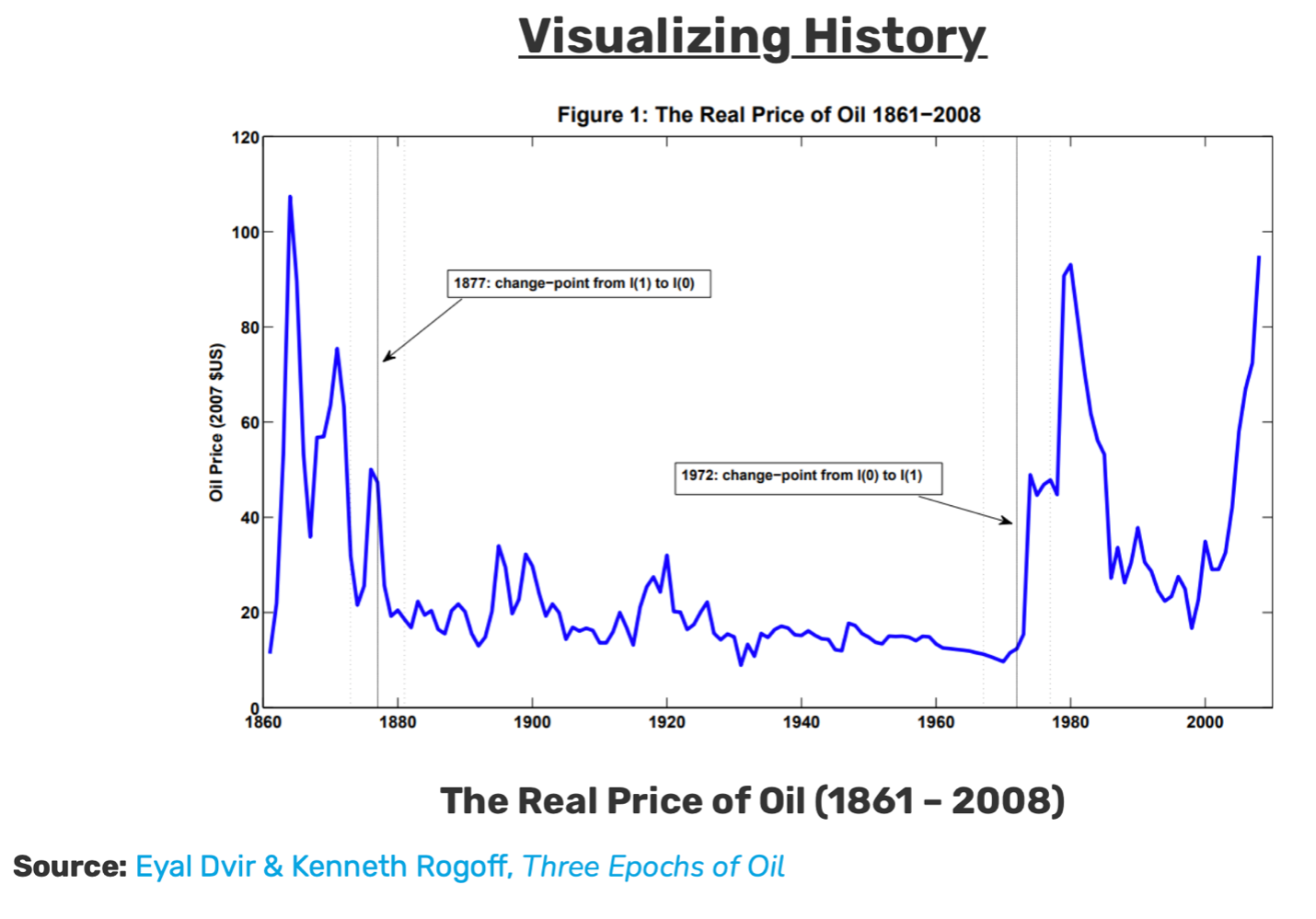
When oil was $120 a barrel I sold 15% of my Exxon and Chevron stock. My rationale at the time was oil companies and prices are cyclical and I thought we were getting somewhat close to the point where demand would decrease (image below) because in the past when America had an oil shock (the oil embargo of 1973, 1979, 1989-90) demand decreased.
The energy companies I added occurred after my sale of Exxon and Chevron in late March when oil was at $110 a barrel because I no longer believed demand would decrease. In fact local governments and foreign governments are thinking of providing subsidies and removing taxes on oil.
In other words, if the government is going to prop-up/sustain demand then oil can increase significantly. Also, this phenomenon is happening throughout the world. Germany has reduced its taxes on oil. Quebec is giving everyone $500 (right before an election). All these policies are going to sustain oil demand.
I have no idea what will happen to Russian oil. Its very possible that most or some of that oil doesn’t end up in the world economy because refiners do not want to take it for fear of bad PR. If the war ended today I still don’t think Russian oil comes back to the world economy instantly; I think it would require a regime change and months of assurances that Russia won’t attack anyone any time soon.
A headwind for the American energy companies is if President Biden invokes an export ban on oil and natural gas. I think an export is highly unlikely but since this is an election year it’s possible the Biden uses his powers and doesn’t allow America’s oil and natural gas to be sent to Europe.
Prosus
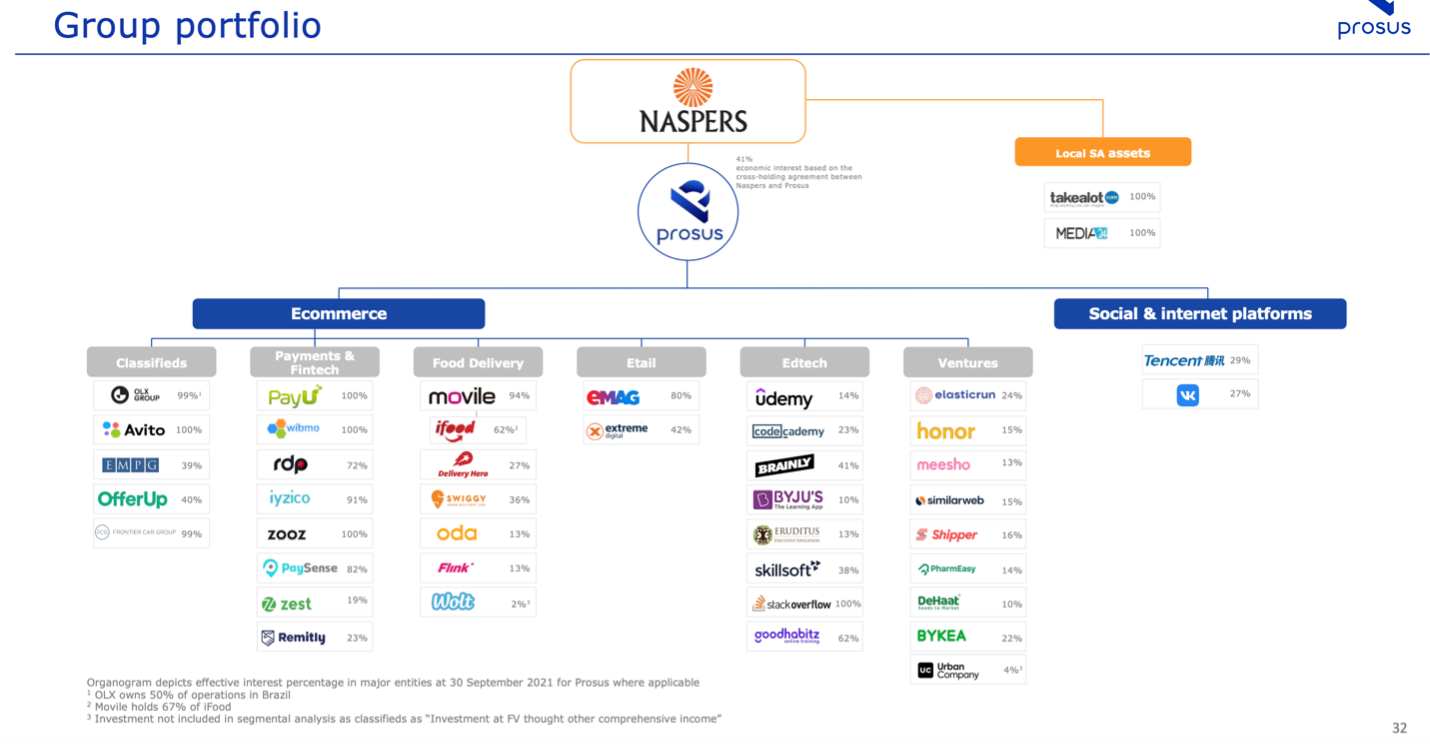
The Dutch-listed technology investor Prosus NV—a subsidiary of the South African tech giant Naspers —owns 28.9% of Tencent. It was 30% but Prosus sold 2% of its shares for $14.7 billion in April. In its September 2021 filing, management has said they will not sell any Tencent stock for three years.
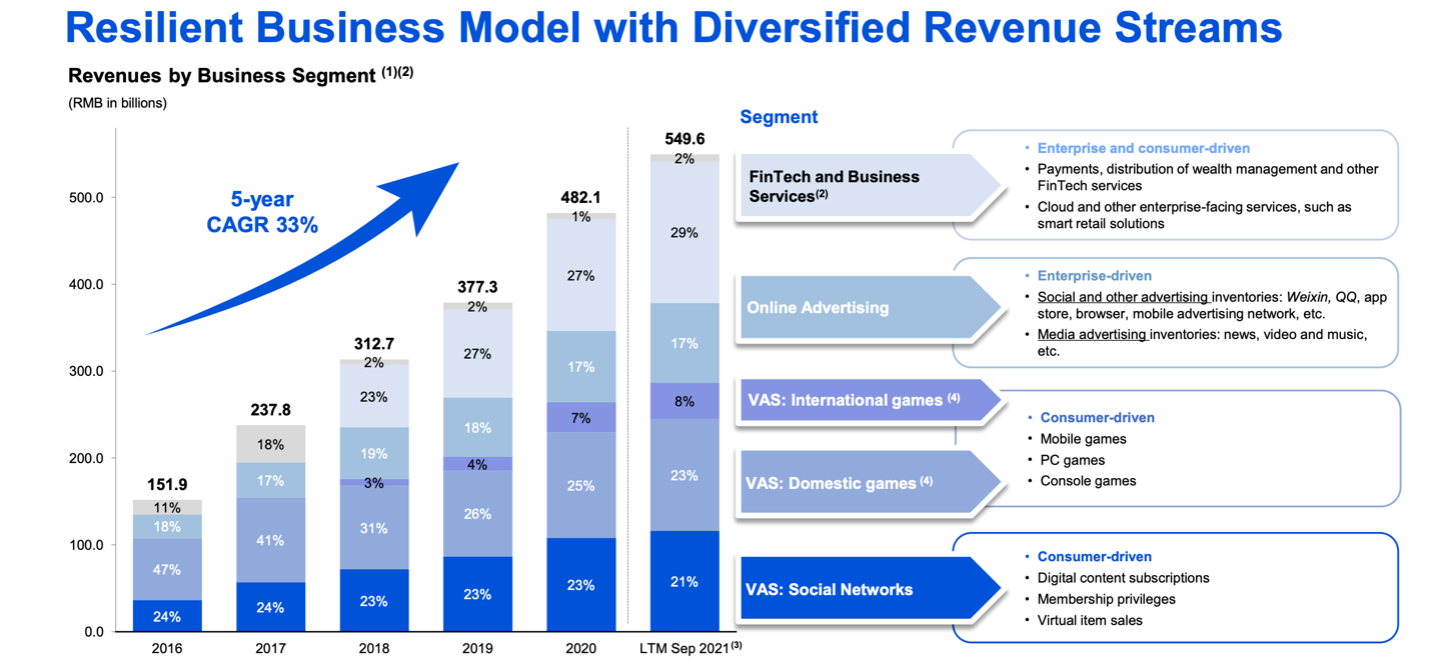
I made 3.25% position in Prosus because I wanted exposure to one of the best companies in China (image below). If this company was domiciled in America instead of China it could possibly have the largest market cap.
Prosus owns about $140 billion of Tencent stock, plus another $10 billion of cash and shares of Delivery Hero, a food delivery company, plus a collection of private-company investments marked at a valuation well over $30 billion (image below). Prosus’ market cap is $113 billion so I’m getting Tencent at a 20% discount and I get all the other companies for free.
The latest quarter was not very good for Tencent. “The October-to-December period rose 7.9% to 144.19 billion yuan, equivalent to $22.65 billion. That missed expectations of analysts polled by FactSet and marked the company’s worst top-line growth since it went public in 2004.”
This comes after a myriad of regulations from the Chinese government. The first was a halt of new game approvals. Then it was the government’s broader, more recent crackdown on a range of subjects, including youth gaming activity, online lending, after-school tutoring and the use of personal information. It is possible their economy is too heavily reliant on housing and as we saw in America what happens when there is an inflated housing bubble. Lastly, its also very possible Tencent’s accounting is fraudulent.
All that said, you don’t have the opportunity to buy the stock at its current price unless there are headwinds. My thesis is either this investment is a zero or I get tremendous compounder. To be honest I originally sized the position to be 5% but I had to reduce my exposure because China-specific headwinds. However, Tencent’s core gaming, advertising, fintech and cloud software franchises are some of the world’s best and its trading at 16 times earnings. I’m okay with losing 3.25% of my money on this bet.
Schwab
This is a company I wish bought more of when it was cheap. When I made my initial investment in April 2020 my thesis was Schwab was a call option on rates eventually increasing that came with a 2% dividend. Since my initial investment I never added to it until this quarter. The reason why I never added to my position was I had no idea Schwab was an exceptional business. They’ve been growing brokerage accounts 5-7% per year for many years and the growth rate has been increasing. They now have their own robo-advisors and expanded their RIA penetration with the acquisition of TD Ameritrade.
Schwab earns most of its profit on the spread on interest rates via the cash deposits held in brokerage and bank accounts of its customers. They approximately have $7.5 trillion in assets. It currently has a market cap of $168 billion, which is pretty cheap if interest rates increase meaningfully. If the Federal Reserve panics after a couple of rate increases like in 2018 and rates come back down then Schwab is expensive in the short term, but if they continually grow the busines will still grow in single low-to-mid single digits.
Aimia
In early February it was announced Aimia would divest its stake in the PLM Loyalty Program with Aeromexico for $517 million. The company has a current market cap of $476 million. Since the announcement the stock is down 6.4%. On their latest earnings release the CEO said, “We also intend to allocate up to $75 million of the net proceeds towards a combination of
opportunistic share buybacks and/or a special dividend to common shareholders.” In other words they may buy back 10% of the shares outstanding.
Aimia has been restricted to buy back its shares because of its current Normal Course Issuer Bid (NCIB). However, they filed a new NCIB and in mid-June they’ll be authorized to buy back its shares.
Is there something I’m missing? I feel like this is a one foot hurdle?
Market Commentary
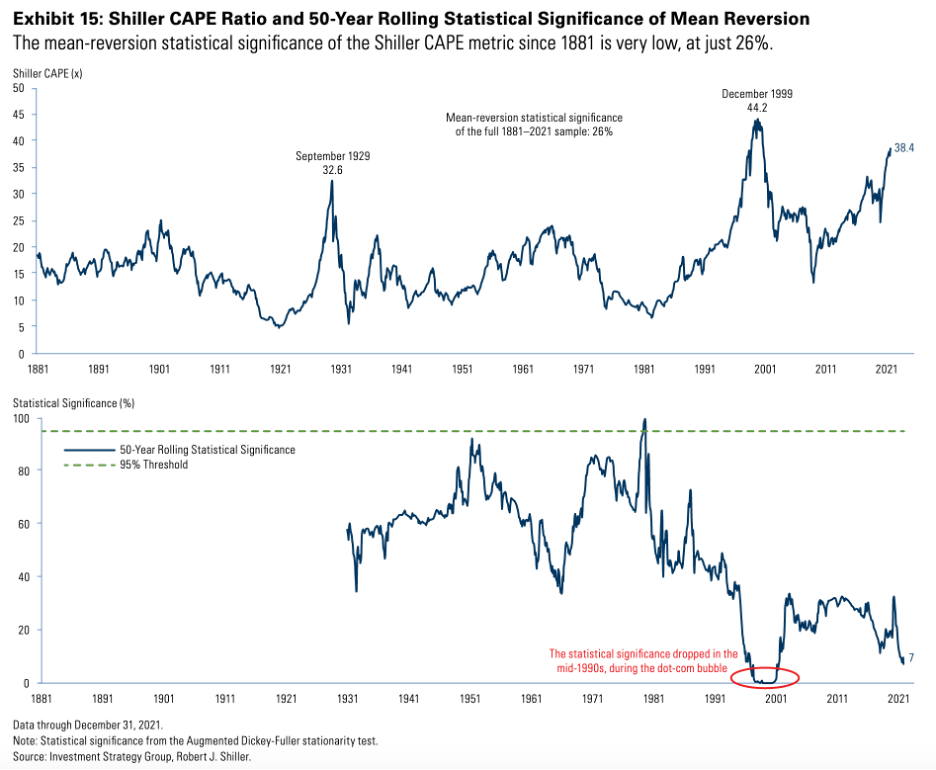
Global inflows into equities have surpassed $1 trillion in 2021, exceeding the combined total from the past 19 years (source: Holger Zschaepitz). The Shiller Cape, at the end of March, is 36, which is really historically. After reading these two metrics its easy to conclude the Market is in a bubble. However, how predictive is the Shiller Cape? The image below is from the 2022 Outlook from Goldman Sachs. The document was released in January.
“The statistical significance over the full sample is 26%. This means that there is only 26% confidence that the Shiller CAPE is mean-reverting, and 74% confidence that it is not. The traditional threshold to consider a relationship statistically significant is 95%. We want to emphasize that valuations alone are not sufficient measures for underweighting equities. High valuations do not reach some magical target and then revert to some stable mean; furthermore, the time period for valuations to reach some long-term average is highly variable and therefore uncertain.”
Another quote from the paper. “There have been 15 Federal Reserve tightening cycles in the post-WWII period. Contrary to received wisdom, not all tightening cycles have led to a recession. Only nine, or 60%, of the cycles did so. Of the last four cycles, only one resulted in a recession: the tightening cycle between June 2004 and September 2006.”
I highly suggest reading it. Its one of the rare papers where I read the entire document; its that good.
I have no idea what’s going to happen with the American economy. I think there are three scenarios:
Inflation comes down towards the end of the year but it stays in the 4-6% range for the next 1-4 years. Despite the inflation Americans continue to spend.
We get a gnarly recession that becomes stagflation.
We get a deflationary bust due to the massive amount of debt.
I think Europe is getting #2 and America will get a mix between #1 and #2. However, I’m not confident in my prediction which is why I’m still mostly invested. Other than my 401k I’m not adding new money to equities and I’m holding cash.
Like most people I’m risk averse and the fact I’ve read a lot of financial history and the boom and bust cycles that occurred regularly only enhances my risk aversion.
At the end of 2021 I read The Great Depression: A Diary by Benjamin Roth and the two biggest takeaways I took was A) make sure you have enough money to survive the downturn and B) the people who did survive didn’t participate in the financial mania.
It’s very possible the Market compounds at 7-plus percent per year for the next couple of years but having the cash makes it extremely easy for me to sleep at night.
The table below is a breakdown of my portfolio at the end of Q1. What you see below where my entire net worth, excluding my home, is allocated. Lastly, my 401k is 100% invested in a Small Cap Value Fund.