
Kennys Vargas 2015 Fantasy Baseball Value

In this year’s fantasy baseball guide (which can still be downloaded for free) I tried to write about every player that could conceivably be owned in a 15-team mixed league. I try to be perfect, but since I’m a one man show some players slip through the cracks. Two players I want to focus on are Kennys Vargas and Steve Pearce. I’ll write about Vargas today and Pearce tomorrow.

When I wrote the fantasy guide I wrote off Kennys Vargas for two reasons: A) his Major League numbers looked unsustainable and B) I thought his he was too big of a player to catch up to premium velocity. However, when I looked at his numbers he performed really well against fastballs (.385/.420/.673 slash line). I also discounted the nine home runs in 234 plate appearances (17.6% HR/FB rate), which when I read his scouting reports here and here, realized the power he showed a legitimate from both sides of the plate. He’s going to hit fourth or fifth in the Twins lineup and if Joe Mauer returns to his .300-plus batting average Vargas is going to have a lot of at-bats with men on-base.

The downside is he struggled immensely against non-fastballs (against both sides of the plate) as he hit .160/.193/.225 with a 35% strikeout rate and 37.7% WHIFF rate. To put the strikeout rate into context, only 12 qualified hitters had a higher strikeout rate against non-fastballs than Vargas. His walk rates in the minors suggests he understands the strike zone, which could indicate his batting eye should improve in 2015. However, in Joe Sheehan’s Newsletter on February 11, 2015 titled “The Transition” (I couldn’t find a way to link to the content; I suggest subscribing and once you do you can read it) he goes into great detail how the strike zone in majors is much bigger than in the minors. He cites this one of the reasons why players in the minors, who had really good walk rates, suddenly look like they have no idea of the strike zone is. This may continue to be a problem for Vargas in heading into 2015.

When I evaluate players with a small Major League sample I lean very heavily on the scouting reports. If Vargas gets a full year of at-bats he should be able to hit 19-plus home runs. The biggest question is at what batting average? He’s not going to have a .340 BABIP again and his minor league track record says the strikeout rate could decrease, but I have my doubts. The fact he struggled so much against non-fastballs indicates there’s going to be a lot of WHIFF in his game and Major League teams will adjust and throw him fewer fastballs. I’m projecting a .242 AVG with 21 home runs, 75 RBI and 65 runs.
Posted in Fantasy Baseball | Leave a comment

Zach Britton’s 2015 Fantasy Baseball Value

If you read my fantasy guide you’ll notice, because of time limitations, I didn’t provide any evaluations of relievers/closers. I would like to add an addendum to the Fantasy Guide by covering a few relievers/closers in the coming days. I don’t have time to evaluate every pitcher, but I want to focus pitchers with varying opinions in regards to their 2015 fantasy value. The first player I want to discuss is Zach Britton.

Last year Britton seemingly came out of nowhere, saved 37 games and was the third best reliever according to ESPNs Player Rater. He’s currently being drafted as the 15th reliever at ESPN, which, on the surface, is extremely low considering how well performed last year. The primary reason for the low ADP is the fantasy community does not believe he can repeat his 2014 season. Is the fantasy community undervaluing Britton?

When first evaluating any pitcher I want to review their lefty-righty splits to see if he doesn’t have any platoon splits. The table below shows his splits from 2011-2013. In 2011 he was starter and made 28 starts. After that season he became a reliever.

Splits PA AVG SLUG OPS BABIP K% BB%
Vs Left 322 .264 .391 .728 .310 20.2% 9.9%
Vs Right 796 .285 .411 .768 .316 12.9% 9.9%

When looking at the table he struggled against righties and lefties, but he was able to miss more bats against lefties, which is understandable because he’s left handed. As a reliever (from 2012-13) he had a .789 OPS. To put that number into perspective that was the fourth highest OPS allowed among relievers with at least 100 innings pitched during the same time frame. Bottom line: he was a bad reliever before 2014.

The fact he was able to be so dominant statistically is a real head scratcher. When looking at his 2014 season it’s hard to overlook the BABIP. Last year it was .215, which was 100 points less than his career prior. What also happened was he generated ground balls at 75% clip, which is extremely high. I prefer pitchers with higher ground ball rates because that indicates he’s inducing more weak contact. Also, considering how good the Orioles infield defense, especially on the left side of the diamond, it’s not surprising the BABIP was so low.

Obviously the BABIP is going to regress, but the big question is how much? The first question I have is can he continue to have a 75% ground ball rate?

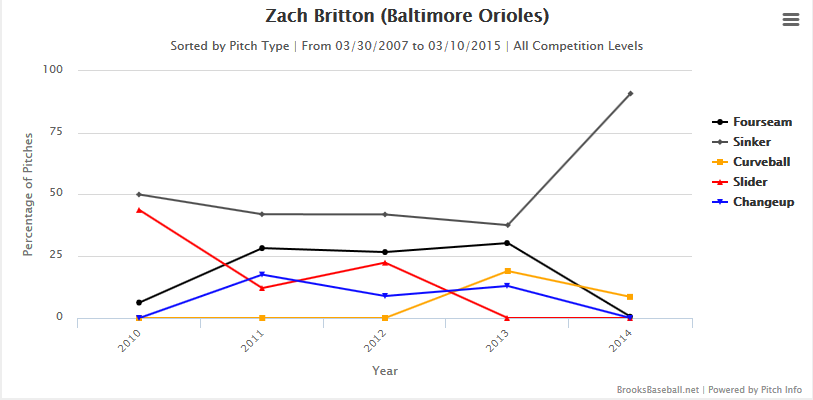
Last year he scrapped the four-seam fastball and changeup, becoming a two pitch pitcher (sinker and slider/curveball). Image below from BrooksBaseball.net.

zach-britton-pitch-usage Since he threw the sinker so much I assumed he threw a higher percentage of pitches down in the zone, but that’s not what the numbers say. The table below shows the percentage of pitches thrown: down, up and middle of the strike zone.

Splits Up Middle Down
2012 19.2% 26.5% 54.3%
2013 22.0% 29.9% 48.1%
2014 21.0% 27.8% 51.2%

The biggest reason why I’m not buying his 2014 numbers was he was extremely lucky when balls were hit on the ground. The table below shows his ground ball performance.

Splits AVG OBP SLUG OPS BABIP
2012 .248 .248 .305 .552 .248
2013 .326 .326 .372 .698 .326
2014 .140 .140 .154 .294 .140

I have my doubts if he can maintain the last year’s ground ball rate, but even if he does he’s not going to have a .140 BABIP again. I expect the ERA to climb to the 3.20-3.50 range next year, but that doesn’t mean he’s going to lose the closer job. The Orioles bullpen doesn’t have a clear reliever overlooking Britton’s shoulder and Buck Showalter has had longer leashes for his closers in the past. Britton would have to struggle terribly to lose the closers role. According to my metrics he’s the 16th best reliever, which means he’s being properly valued by the fantasy community.

Posted in Fantasy Baseball | Leave a comment

2015 12-Team Fantasy Baseball Auction Values

After releasing my 2015 fantasy guide, which you can download for free, I took a much needed break. After I got to recharge the batter I’m proud to share my 12-team mixed league action values (for redraft leagues). If you have any questions about my valuations you can reach me on Twitter @MattCommins.

You can download my values here.

Before downloading please read my methodology. I believe in the SGP method to determine my values. I’ve looked at the PVM and Standard Deviation models, but SGP method makes the most inherent and practical sense. I do not believe there is a 100% accurate way to generate values.

My values are based on a 70%/30% allocation for hitting and pitching respectively. The commonly used breakout is 67%/33%, which is totally fine. However, since I’ve been playing fantasy baseball for more than ten years I know my strength is finding pitching on the waiver wire so my draft strategy is to be as aggressive as possible with hitters because I know I can find pitching later in the season.

When you download my values you’ll notice there are no $1 players and the total doesn’t add up to $3,120 (assuming each player has a budget of $260). That’s because I used mono (i.e. AL or NL-only) league values. “But Matt your values are for mixed leagues, not mono leagues!” I’ve tried creating auction values with mixed league formulas, but I haven’t found a way to provide values that accurately reflect how much players will go for in drafts.

For example, my mixed league values say Mike Trout is worth $32. My AL-only value says he’s worth $41.5. Of the two values he’ll likely go between $41-45 on draft day. So instead of continuing to find the proper mixed league formula I’ve decided to use mono values and create a rule of thumb for my valuations for mixed leagues. This is the same rule of thumb I used last year and I had really good results.

That rule of thumb can be found in the tables below. If a hitter is valued between $26-30 then he’ll likely go for a $1-7 discount during the auction. The goal of the draft is to accumulate as much value as possible for the lowest cost. Therefore, my minimum discount is $7. These tables are largely based Larry Schechter’s book: Winning Fantasy Baseball.

Hitters’ Values Avg. Price Range Minimum Discount
$31+ $2 discount to overpay by $2 $2
$26-30 $1-7 $7
$21-25 $5-11 $11
$17-20 $10-14 $14
$13-16 $10-14 $14
< $12 Only pay $1 –
Ptichers’ Values Avg. Price Range Minimum Discount
$31+ $2-6 $6
$21-30 $3-7 $7
$9-20 $4-8 $8
< $8 Only pay $1 –

Lastly, you’ll find my system for evaluating catchers. Catcher is the only position that truly is scarce. The reason why I say that is because if you have $1 left you’ll get much more value drafting any other hitter than a catcher with that $1.

Catchers’ Values Avg. Price Range Minimum Discount
$17+ $2 discount or overpay by $2 $2
$11-16 $1-5 $5
$6-10 $2-6 $6
< $5 Only pay $1 –
Posted in Fantasy Baseball | Leave a comment