
2014 fantasy baseball capsule: Matt Carpenter

It’s been awhile since I posted here, but I assure it is not for a lack of #want. Instead I’ve writing for TTFB and Baseball Professor. I wrote about Eric Hosmer at TTFB and Chris Davis at Baseball Professor. If you want to stay current on what I’m writing your best bet is check out those sites. In the next few days you’ll see I profiled Ian Kinsler and Jason Kipnis. Below is the player capsule for Matt Carpenter. The “RK” refers to the positional rank and are subject to change. The “Player Rater” numbers are positional player rater values taken from ESPN and NFBC.

Bats: L | Age: 27 | Team: Cardinals | Position: 2B, 3B | RK: 3 | Player Rater: ESPN (3), NFBC (4)

A show of hands of who saw Carpenter putting up the season he did in 2013? I literally had no idea he had this in him. In last year’s guide I had him as a fringe top 15 second base candidate who could score some runs, provide a little pop, but ultimately would regress because the BABIP was not repeatable. Not only did he repeat the BABIP, it actually increased. As of now, Carpenter is my second ranked second baseman because he provides two elite category statistics: runs and batting average. One could argue there’s no way the Cardinals are going to hit .330 again with men in scoring position so Carpenter’s major league leading run total will decrease. That’s true, but the Cardinals should replace Pete Kozma at shortstop and they’re replacing Carlos Beltran with Matt Adams and David Freese with Kolten Wong so the offense should be at the very least the same as last year. On the surface Carpenter’s RBI total seems really high a leadoff hitter in the National League. Among second basemen he only ranked 18th in plate appearances with runners in scoring position, so it’s likely his .413 batting average will regress and therefore his RBI totals should regress. The bat is for real; he can hit righties and lefties and most importantly, reduced his strikeout nearly five percentage points while maintaining his walk rate.
Posted in Fantasy Baseball | Leave a comment

2014 fantasy baseball capsule: Buster Posey

With the World Series coming to a conclusion, every baseball must now endure the winter with no baseball. The best way for me to brave through these five months is thinking about the game and specifically, evaluating a player’s fantasy baseball value. Last year I wrote my first fantasy and although I’m very proud of the work, there were still silly errors, grammar mistakes and frankly, bad analysis in certain spots. This year I’ve begun the construction of the 2014 guide two months earlier and will be ready to go by the end of February.

Without further adieu below is my first player capsule for Buster Posey. The “RK” refers to the positional rank and are subject to change. The “Player Rater” numbers are positional player rater values taken from ESPN and NFBC.

Bats: R | Age: 27 | Team: Giants | Position: C | RK: 1 | Player Rater: ESPN (7), NFBC (5)

Last year I said it was crazy for Posey to have an ADP of 18.25 (in NFBC) and 17.3 (in ESPN) because he clearly was not going to hit .385/.456/.649 for an extended period of time again and not provide the same value as 2012. Turns out, I was right. Hooray! That said, I still had him rated as the best catcher, which turned out to be wrong. Looking at the baseball cards stats it’s easy to see why he finished so low. His power numbers and batting average decreased to career lows (for a season with at least 100 games played). Before 2013, his career HR/FB rate was 15.5 percent, last year it was 9.7 percent. The amount of ground and fly balls that were hit were essentially the same over his career, which leads me to believe his HR/FB rate should increase towards the 13-14 percent range. Prior to 2013 his career BABIP was .339, but last year it was only .312; obviously it appears he got a little unlucky with balls in play and the manifestation of that is shown through the well hit average (WHAV). In 2010 and 2012 his WHAV was .301 and .288 respectively. However, last year it was only .247. I expect a rebound season where he’ll finish the year with a .310 batting average with 20 home runs.

Posted in Fantasy Baseball | Leave a comment

Pitcher strikeout rate thresholds for 2014

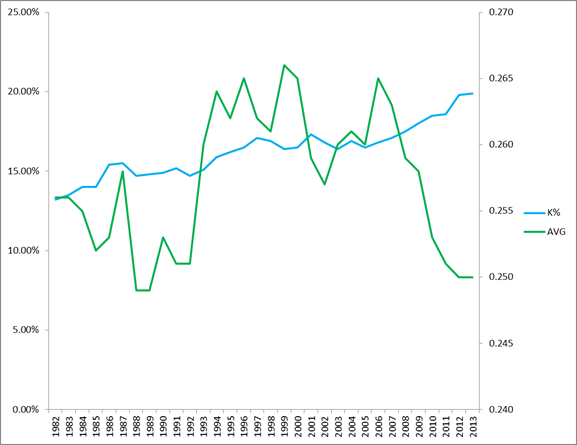
By now, we fantasy aficionados all aware of we’re at historic levels in terms of strikeout rates. Since 2008, strikeout rates have increased year over year and 2013 was even higher (0.1 percent) than 2012. Therefore, it’s important to adjust the strikeout rate used a benchmark when evaluating starting pitchers for 2014. The graph below shows pitcher’s strikeout rates and batting average against since 1982.

1982-2013-strikeout-rateOn draft day every fantasy owner should have targets for each category. In general, it takes roughly 90-92 points to win a 5×5 roto league with 12 teams with weekly lineups. Therefore, fantasy owners should strive to finish third and fourth in every category.

For strikeouts, last year 1,400 strikeouts was more or less were the requirement. A pitching staff (with nine pitchers starting) will throw roughly 1,494 innings, of which, 1,314 will come from starting pitchers and 180 innings from relievers. In terms of the strikeout ratios, 85-88 percent of the strikeouts will come from starting pitchers. If you take 1,400 and multiple it by 87 percent you get 1,218 strikeouts needed from starters and 182 from relievers.

Now that we have these two end points we can calculate what strikeout rate is needed from starting pitchers in order to achieve 1,218 strikeouts. On average a starting pitcher has 4.25 plate appearances per inning so if you multiply 4.25 by 1,314 you get 5,584.5; if you divide that number by 1,218 you get 21.81 percent. Therefore, starting pitchers need to have a strikeout rate of 21.81 percent in order to achieve 1,218 strikeouts.

Last year there were only 44 pitchers who pitched at or above the 21.8 percent threshold (with at least six games started). With strikeouts at such a premium, rostering extremely high strikeout pitchers such as Yu Darvish and Max Scherzer will provide extra roster flexibility and allow fantasy owners to win the strikeouts category.

Random tangent, suppose Darvish did not lose the four 1-0 games and finished the year with 16 wins instead of 13, rating Darvish as the number one fantasy pitcher would have more support. That said, the more I’m thinking about it, the more I like Darvish as my number one pitcher next year.

In order to finish third in saves requires approximately 99-103 saves, which is only 33 saves per pitcher (supposing you draft three closers). Using the same method outlined above, the strikeout rate needed from closers is 24.5 percent. The math calculation is as follows: 180 innings multiplied by 4.13 (plate appearances they face per inning) equals 743.4; 182 strikeouts divided by 743.4 equals 24.5 percent. Most closers fulfill this strikeout rate so during the evaluation period fantasy owners should focus on the pitchers job security and overall effectiveness.

It’s also possible to fulfill this requirement by drafting closers near the end of your drafts. For example, last year I drafted Grant Balfour, Jason Grilli and Casey Janseen in the 16th and 17th round and their final totals were 105 saves and 196 strikeouts, both of which are above the thresholds needed for this category. In 2014 let the Craig Kimbrell, Aroldis Chapman and Kenley Jansen proponents use an early 5th-7th round pick on them and you can wait on saves.

Posted in Fantasy Baseball | Leave a comment