
Runs Scored, the Overlooked Stat in Fantasy Baseball

Pitching has become more dominant than ever. The manifestation of this dominance can be shown in the number of runs scored per game. During the last two years the average runs per game has not been this low since 1992. Below is a graph of the average runs per game since 1980. The green line represents the average (4.55 runs).
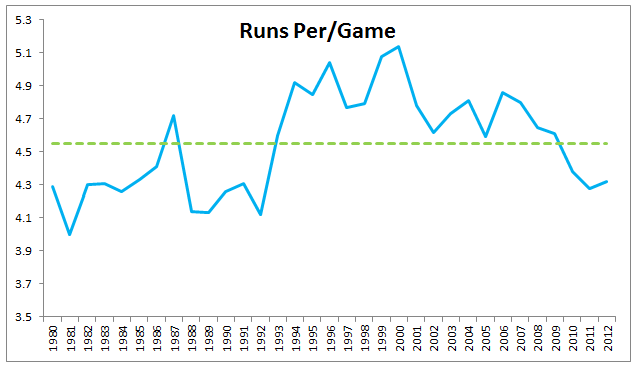
runs per game
During our draft prep, we (fantasy owners) can often times have the blinders when on when it comes to the evaluation of and ranking of hitters. More specifically, we only focus on players who hit home runs, generate RBIs, and steal a lot of bases. I was not immune to this way of thinking as well. If you check my initial rankings in my fantasy guide you’ll notice I completely buried players how could score a lot of runs and propped up players who hit a lot of home runs. Quick guess, how many players scored 85+ runs last year? 48, that’s it. Last year it was 37! Let’s not jump the gun here. Maybe scoring runs isn’t as scarce as home runs. The table below shows the number of players who scored 85+ runs and 25+ home runs.

Year

85+ Runs

25+ Home Runs

1980

33

17

1982

49

29

1983

29

22

1984

39

25

1985

36

31

1986

44

31

1987

60

53

1988

32

22

1989

24

18

1990

34

22

1991

40

31

1992

35

20

1993

52

31

1995

42

37

1996

80

61

1997

71

49

1998

84

52

1999

94

64

2000

90

67

2001

65

65

2002

67

54

2003

68

57

2004

75

58

2005

60

45

2006

78

54

2007

74

46

2008

69

50

2009

58

55

2010

49

44

2011

37

42

2012

48

44

I starting playing fantasy baseball in the late 90s when scoring a lot of runs was common. However, with runs becoming more of a premium, players who score a lot of runs are just as scarce as home run boppers. Currently players who are projected to score a lot of runs and steal a lot of bases: Ben Revere, Denard Span, and Jon Jay have only have ADPs (at Mock Draft Central) of 190, 237 and 265 respectively. However, power only players are going higher in drafts. For example, Kendrys Morales, Ryan Ludwick and Dayan Viciedo have ADPs of 148, 158 and 183 respectively.

I recommend “reaching” for players (Revere, Span, or Jay) who are expected to bat lead off for a team the entire year than players whose primary upside is only power (Ludwick and Viciedo) because power will be easier to find later in drafts. For example, last year 79 players hit 20+ home runs compared to only 61 players scoring 80+ runs.

The key for scoring a lot of runs is a function of opportunity and skill. The higher a player hits in the lineup, the greater the likelihood he’ll score runs. Last year lead off hitters scored the most runs than any other position. Batting second and third were second and third respectively.Below are players you could draft late in the later rounds who could score 85+ runs.

Player

Whoever bats second in the Angels Lineup

Josh Rutledge, COL

Daniel Murphy, NYM

Dustin Ackley, SEA

Yunel Escobar, TB

Denard Span, WSH

Michael Young, PHI

Ben Revere, PHI

Angel Pagan, SF

Dexter Fowler, COL

Alejandro De Aza, CHW

Norichika Aoki, MIL

Jon Jay, STL

Posted in Fantasy Baseball | Leave a comment

Players to Avoid in the First Four Rounds

If you read The Importance of a First Round Pick you have seen that only half of the top-10 picks taken in the last four years have finished in the top 40 of ESPNs Player Rater. Of those 40, only ten players finished in the top ten. I’m a big believer you can’t win your league in the first three rounds, but you can lose it. Therefore, it’s important to get good value from your first three picks. In order to mitigate this it’s important to avoid players who are being overvalued and/or overhyped. Below are four players that are being drafted too high. Please note Chase Headley and Buster Posey would have made the list, but I’ve written player profiles for them already at here and here respectively. Lastly, all ADPs come from Mock Draft Central.

Andrew McCutchen
Bats: R | Age: 26 | Team: Pirates | Position: OF | ADP: 5.63

McCutchen finally had his break out season, hitting 31 HRs and putting up a slash line of .327/.400/.553 along with 20 SBs. What’s most impressive is he was able to put up these numbers in PNC Park, the hardest ballpark in the league for right handed power. However, there are some red flags. First, his batting average; last year he had a .327 batting average, which was aided with a .375 BABIP. Before last year his career batting average was .276. Second, most of his fantasy value came in the first half of the season. 58% of his home runs and 70% of his stolen bases came in the first of the season. Also, his slash line in the first half was .362/.414/.625 compared to .289/.385/.475 in the second half of the year. Third, his stolen bases have decreased year over year for the past three years, reaching a career low of 20 last year. He’s currently being drafted 5th/6th overall, which is too high. I bet at the end of the year he provides similar value to Adam Jones, whose going 15-16 picks later.

Jose Bautista
Bats: R | Age: 32 | Team: Blue Jays | Position: OF | ADP: 9.01

Bautista is going to be one of the most polarizing players going into drafts; he’s either going to win or cost fantasy players their championships based on his ADP. His 2012 season was cut short because he had surgery on a damaged tendon in his left wrist. A hitter’s hands and wrists are extremely important to hitting and hitting for power. Stephania Bell, a licenses physical therapist at ESPN, said the surgery reattached the soft tissue and not the tendon; therefore it was a minor wrist surgery. It’s easy to assume he will come back to the production we saw back in 2010 and 2011, but I’m extremely skeptical. His biggest fantasy asset is his power, if he doesn’t hit for power he’s a top 50 player and not a top-ten player. Also, he’s not going to help in the batting average department; in 2011 he batted .302, but that was BABIP driven. So far in spring training he’s 2 for 16 with both of those hits being home runs. However, those home runs came against Aaron Cook and Troy Patton.

Justin Upton
Bats: R | Age: 25 | Team: Braves| Position: OF | ADP: 11.35

Based on his 2011 season I thought Upton was on the precipices of becoming an MVP. But what happened instead is he took a huge step backwards, only hitting 17 home runs, 18 stolen bases and 67 RBI. His lack of power and offensive output was partly due to a thumb injury that became public only after the season ended. What also could have contributed to his poor year was he didn’t get along with the Diamondbacks coaching staff and upper management. The biggest hesitation I have about him is he’s never been an top-10 player before. Even during his best season (in 2011) he only finished 17th on ESPNs Player Rater. Most scouts would agree he has tools to hit .300 with 30+ home runs and 30+ stolen bases, but he is moving from a great hitter’s park to a ballpark that is the eighth worst for right handed hitters. Some could argue that’s not a big deal because Atlanta’s park is a neutral ballpark, but check out his home-road splits for the past three seasons; it’s very clear to me he benefited from playing in Arizona’s ballpark.


AB

R

H

HR

RBI

SB

CS

AVG

OBP

SLG

OPS

Home

781

149

243

39

131

20

13

.311

.392

.536

.928

Away

860

136

218

26

93

37

12

.253

.331

.408

.739

Ian Kinsler
Bats: R | Age: 31 | Team: Rangers | Position: 2B | ADP: 38.45

Despite playing the most games he’s ever played in his career, he only finished 5th on ESPNs Player Rater among second basemen. He has 30/30 upside and plays a relatively weak position so it’s natural for fantasy owners to take him 38th/39th overall, but there a lot of red flags. First, his home-road splits are skewed heavily towards playing in Arlington (table below). He continues to be a <.227 hitter on the road I don’t see him hitting .280 again. Second, Lance Berkman is replacing Josh Hamilton in the lineup. No matter how good Berkman is, he’s not going to provide the production Hamilton provided. Therefore, his run totals are likely to decrease, especially if his OBP is below .330 again. Kinsler is a player you draft and leave him in your lineup regardless of the matchup (this excludes H2H leagues). Kinsler has an extremely wide range of outcomes; he could go 30/30 again or put up an average 20/20 season. I prefer consistency with my four picks, but there are two scenarios, although unlikely, I envision myself drafting Kinsler: 1) If I draft three “safe” players with my first three picks or 2) I go with high upside, high risk players with my first three picks.

AB

R

H

HR

RBI

SB

CS

AVG

OBP

SLG

OPS

Home

820

180

246

34

106

41

12

.300

.398

.506

.904

Away

846

119

192

26

88

25

6

.227

.302

.377

.679

Posted in Fantasy Baseball | Leave a comment

Starting Pitching Fantasy Baseball Strategy

Last night I participated in my first 12-team NFBC mock draft at Mock Draft Central; I’ve only done 10 and 15 team mocks so far. I purposely didn’t have a game plan entering the mock because I wanted to see my gut reaction to each pick and analyze afterwards. Below is my team:

Player

Team

Position

Round

Pick In Round

Overall Pick

Carlos Gonzalez

COL

OF

R1

P9

9

Troy Tulowitzki

COL

SS

R2

P4

16

Jason Heyward

ATL

OF

R3

P9

33

Yoenis Cespedes

OAK

OF

R4

P4

40

Pablo Sandoval

SF

3B

R5

P9

57

Gio Gonzalez

WAS

SP

R6

P4

64

Eric Hosmer

KC

1B

R7

P9

81

Ike Davis

NYM

1B

R8

P4

88

Matt Moore

TB

SP

R9

P9

105

Jordan Zimmermann

WAS

SP

R10

P4

112

Martin Prado

ARI

OF

R11

P9

129

Hiroki Kuroda

NYY

SP

R12

P4

136

Brett Gardner

NYY

OF

R13

P9

153

Rickie Weeks

MIL

2B

R14

P4

160

Jake Peavy

CHW

SP

R15

P9

177

Jon Lester

BOS

SP

R16

P4

184

Bruce Rondon

DET

RP

R17

P9

201

Jose Veras

HOU

RP

R18

P4

208

Chris Carter

HOU

1B

R19

P9

225

Brandon League

LA

RP

R20

P4

232

Welington Castillo

CHC

C

R21

P9

249

John Jaso

OAK

C

R22

P4

256

Daniel Murphy

NYM

2B

R23

P9

273

I was very happy with my team, especially with my offense. I ended up taking four pitchers in my top 12, which was a huge mistake. Of the four pitchers, I regret taking Gio Gonzalez in the 6th round because really good hitters such as Alex Gordon were still available. I took Brett Gardner, whose average ADP is 205, in the 13th round (153rd overall) because he could legitimately lead the league in stolen bases. Based on his average ADP it could be seen as though Gardner was an overdraft, but I disagree. If you read my fantasy guide you’ll see I believe in taking the players you want regardless of their ADP.

According to PECOTA, from Baseball Prospectus, I would have finished 4th in hitting and 11th in pitching. I don’t a lot of stock in the pitching totals because with so many auto-picks (only five people showed up) closers went very early in the draft; anyway, if I took an Alex Gordon I could have been in the top 3. Enough self-indulgence; I want to talk about starting pitching depth.

A common strategy most fantasy owners will employ on draft day is to wait for pitching. Since starting pitcher is the deepest position it’s logical to want fill that position after the more scarce positions (shortstop, second base) have been filled. The primary reason for waiting on pitching is pitchers have a higher likelihood of getting hurt despite even the best of track records; I’m looking at you Roy Halladay, Tim Lincecum and Dan Haren. What often gets overlooked is since pitching is so deep every team is going to have good pitching staffs! Therefore, you’re going to need a great pitching staff in order to finish in the top three of each category.

A misconception I had was since starting pitchers only contribute to four out of five categories they’re less valuable. However, if a pitcher throws 200 innings, those innings will comprise 13.7% of the total output; a nine player pitching staff will throw roughly 1,458 innings. While a batter with only 630 plate appearances will comprise of 7.2% of the total plate appearances. Therefore, the value of a batter and pitcher is roughly the same. 

There are three basic strategies fantasy owners can employ on draft day:

  1. Wait on pitching and draft hitters. This strategy will allow you to gain a superior advantage in every hitting category. If you choose this strategy you’re going to have to find sleepers throughout the waiver wire and stream pitchers every week. I love this strategy because I know I’m smarter than every player in my league and that I can outplay them. In that 12-team mock a lot of my favorites such as Jeremy Hellickson, Marco Estrada, James McDonald, Brandon McCarthy, and Lance Lynn were all available in the 21st round or later.
  2. Draft a fantasy ace. This is a high risk strategy because there are only five aces: Justin Verlander, Clayton Kershaw, Stephen Stasburg, Cliff Lee and Cole Hamels. This is high risk because you’ll likely have to use one of your top three picks in order to get them, but if you do you’ll have more flexibility throughout the rest of your draft. I recommend getting one “Tier 2” (check out the fantasy guide for the definition) starter in addition to the ace and then wait until the end of your draft to fill out the rest of your pitching staff. This strategy is more ideal for players drafting at the end of the first round because there are very few safe hitters; who do you trust more Troy Tulowitzki nor Clayton Kershaw?
  3. Draft three Tier 2 pitchers. This will allow you to spread the risk over three pitchers, but if one of them gets hurt you’re going to be more vulnerable to better pitching staffs. This is my least favorite strategy because you’re setting yourself up for mediocrity; you won’t have an elite pitching staff or lineup; you’ll have to be extremely aggressive on the waiver wire for both hitters and pitchers all year.

There is no ideal strategy because if each is played correctly you’ll be able to win your league. I suggest doing a few mock drafts to get an idea how you want to approach your drafts. Just like any skill, it takes a lot of practice before you become good.

Posted in Fantasy Baseball | Leave a comment